
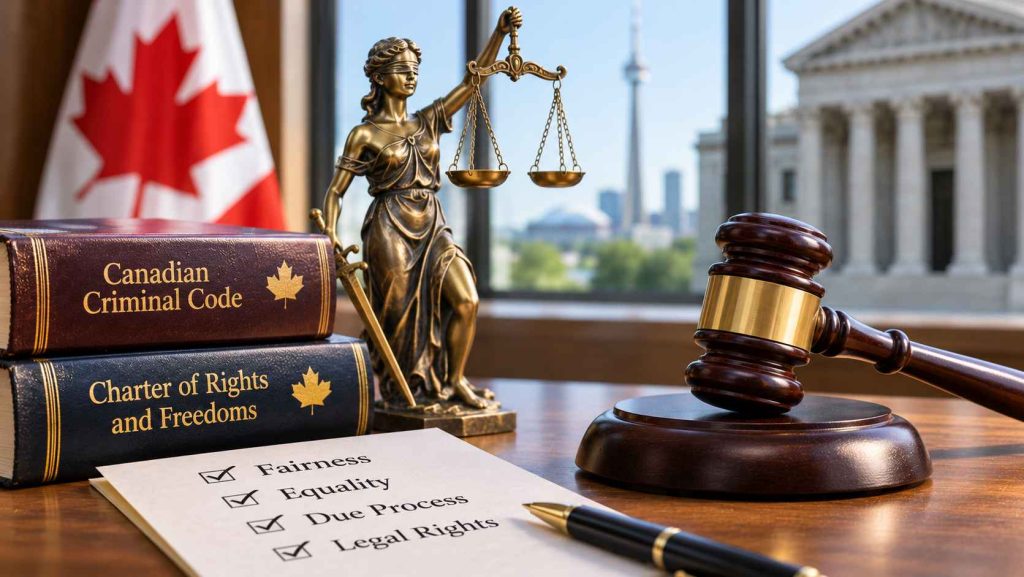
Fairness and equality are fundamental principles of Canada’s criminal justice system. When someone is accused of a criminal offence, the legal process must balance several important responsibilities, including protecting individual rights, examining allegations carefully, and maintaining public safety.
Criminal allegations can have serious consequences for everyone involved. Accused individuals may face uncertainty about their future, while complainants and victims may experience significant emotional and personal challenges. A fair justice system must recognize these different experiences while ensuring that legal decisions are based on evidence rather than assumptions.
Understanding due process helps Canadians recognize why legal protections matter and how they contribute to a justice system that treats individuals with dignity and respect.
The Presumption of Innocence: A Foundation of Canadian Justice
One of the most important principles in Canadian criminal law is that a person accused of an offence is presumed innocent until proven guilty.
This means a criminal charge does not automatically establish responsibility for the alleged conduct.
The prosecution must prove guilt beyond a reasonable doubt, a legal standard designed to protect individuals from wrongful convictions.
The presumption of innocence applies regardless of a person’s background, financial circumstances, occupation, or public reputation.
Criminal defence professionals, including Stephen Jack Criminal Lawyer, work within this framework to help accused individuals understand their legal rights and navigate criminal proceedings.
Importantly, the presumption of innocence does not mean allegations should be ignored or that complainants should be dismissed. Rather, it ensures that allegations receive careful examination before legal conclusions are reached.
How Canada’s Criminal Law Framework Supports Due Process
Due process refers to the legal protections and procedures that help ensure fair treatment throughout investigations and court proceedings.
Canada’s criminal justice system operates under several important legal frameworks, including the Canadian Charter of Rights and Freedoms and the Criminal Code of Canada.
The Criminal Code defines many criminal offences and establishes procedures relating to arrests, bail, trials, and sentencing.
The Charter provides constitutional protections, including the right to a fair hearing, the presumption of innocence, and protections against unreasonable search or seizure.
These rules help ensure that criminal investigations and prosecutions take place within established legal boundaries.
Due process also promotes accountability by requiring legal authorities to follow applicable procedures rather than making decisions based solely on suspicion or public pressure.
Understanding Legal Rights During Criminal Investigations
The protection of individual rights begins before a criminal case reaches trial.
When police investigate suspected criminal activity, they must operate within the limits established by Canadian law.
Individuals who are arrested or detained have important constitutional protections, including the right to be informed promptly of the reasons and the right to retain and instruct legal counsel without delay.
Legal protections relating to silence and self-incrimination also play an important role.
Depending on the circumstances, police may gather witness statements, examine electronic communications, collect physical evidence, or conduct searches where legally authorized.
These investigative powers are subject to legal requirements intended to protect individuals from improper government interference.
Understanding these rights helps people recognize that police investigations must follow established rules, even when allegations are serious.
Legal protections apply regardless of whether an individual is ultimately convicted or acquitted.
Why Independent and Impartial Courts Matter
An independent judiciary is essential to maintaining fairness within the criminal justice system.
Judges must assess cases according to the law and the evidence presented, without improper influence from political authorities, public opinion, or personal prejudice.
Judicial independence helps protect the decision-making process from outside pressure.
Impartiality requires courts to approach proceedings fairly and avoid prejudging the individuals involved.
During criminal trials, the prosecution and defence perform different roles. The prosecution presents the case against the accused, while the defence may challenge evidence, question witnesses, and raise relevant legal arguments.
The court must evaluate the admissible evidence and determine whether the applicable legal standard has been satisfied.
These safeguards support fair proceedings for accused individuals while respecting the legitimate interests of complainants, victims, and the wider community.
Why Evidence Must Matter More Than Assumptions
Criminal allegations can attract attention from news outlets, social media, and local communities.
However, information circulating publicly may be incomplete, disputed, or presented without sufficient context.
For this reason, Canadian criminal courts rely on legally admissible evidence rather than speculation.
Evidence may include witness testimony, documents, electronic records, photographs, forensic findings, and other relevant information.
Each type of evidence must be evaluated according to applicable legal principles.
Witness accounts, for example, may require examination of memory, consistency, credibility, and surrounding circumstances.
Similarly, electronic communications may need to be considered alongside the broader context in which they occurred.
The responsibility of determining criminal guilt belongs to the legal process, not to public opinion.
This approach protects accused individuals from premature judgments while ensuring that allegations receive appropriate consideration.
How Social Background and Personal Circumstances Can Affect Legal Experiences
Although legal rights apply broadly, individuals do not necessarily experience the criminal justice system in the same way.
Financial resources, language barriers, education, disability, cultural differences, and access to community support can influence someone’s ability to understand or navigate legal proceedings.
For example, an individual unfamiliar with legal terminology may struggle to understand court documents or procedural instructions.
Others may face difficulties obtaining legal representation, arranging transportation, attending court appointments, or balancing employment and family responsibilities.
These challenges can affect how individuals participate in the legal process.
Equality before the law requires that legal standards be applied fairly, while meaningful access to justice also involves recognizing barriers that may prevent people from exercising their rights effectively.
Interpreters, legal aid services, accessibility accommodations, and other appropriate supports can help address certain barriers.
Recognizing different personal circumstances does not mean changing the criminal standard of proof. It means acknowledging that fairness may require practical measures to support meaningful participation.
The Importance of Access to Legal Representation
Legal representation helps individuals understand criminal allegations and participate meaningfully in proceedings.
Criminal law involves technical rules governing evidence, disclosure, procedural requirements, and courtroom processes.
Without sufficient legal knowledge, accused individuals may find these issues difficult to navigate.
A criminal defence lawyer may review disclosure, explain applicable legal rights, assess the evidence, communicate with prosecutors, and represent the accused in court.
For sensitive allegations, including sexual offences, the legal process may involve additional evidentiary rules and procedural protections.
Individuals seeking information about sexual assault defence legal services may benefit from understanding how legal counsel approaches these complex matters while respecting the rights and dignity of everyone involved.
Access to counsel does not guarantee any particular legal outcome. It helps ensure that relevant legal issues are identified and that accused individuals have an opportunity to present their position through established procedures.
Respecting the Rights and Experiences of Everyone Involved
Fairness in criminal justice must extend beyond any single participant.
Complainants and victims may experience significant emotional, physical, or financial consequences connected to alleged criminal conduct.
Their experiences deserve respect, and legal procedures should not unnecessarily undermine their dignity or safety.
At the same time, accused individuals are entitled to fundamental legal protections, including the presumption of innocence and the right to a fair trial.
These responsibilities are not mutually exclusive.
A justice system can take allegations seriously while maintaining rigorous standards of proof and fair procedures.
Respectful treatment, appropriate safeguards, and careful evaluation of evidence contribute to a process that recognizes the interests of everyone involved.
Why Fair Treatment Strengthens Public Confidence
Public confidence depends partly on whether people believe the justice system applies the law consistently and makes decisions through transparent, accountable procedures.
When individuals see that allegations are investigated properly, legal rights are respected, and courts assess evidence independently, confidence in legal institutions can be strengthened.
Conversely, unfair treatment, discrimination, or decisions influenced by assumptions can weaken trust.
Fair procedures also demonstrate that the law applies to individuals regardless of their social position or personal circumstances.
This commitment to fairness is important in a diverse society where people bring different experiences and expectations to public institutions.
Conclusion: Fairness and Equality Are Essential to Justice
Canada’s criminal justice system relies on the principles of fairness, equality, and due process to protect individual rights and support responsible legal decision-making.
The presumption of innocence, access to legal representation, impartial courts, and careful examination of evidence all contribute to this framework.
Recognizing social barriers and respecting the experiences of complainants and accused individuals are equally important to maintaining public trust.
Ultimately, a fair criminal justice system is not defined by any particular outcome. It is defined by its commitment to applying the law consistently, respecting human dignity, and ensuring that decisions are reached through lawful and impartial procedures.